starlume production studio

AI-assisted documentary studio · Two films finished · October 2026

Short documentaries made by an AI crew, with one human producer.

Claude agents research the story and write the script. ElevenLabs gives it a voice, a score and sound. Blender draws the maps, graphics and 3D, and ffmpeg mixes the film. The producer approves the concept, the script and the storyboard before any money is spent, and watches every cut.

2 films, 3:52 and 4:43 ~$64 and ~$101 all-in at API prices ~2 h and ~2.5 h of working time ~$17 of Claude plan value for both

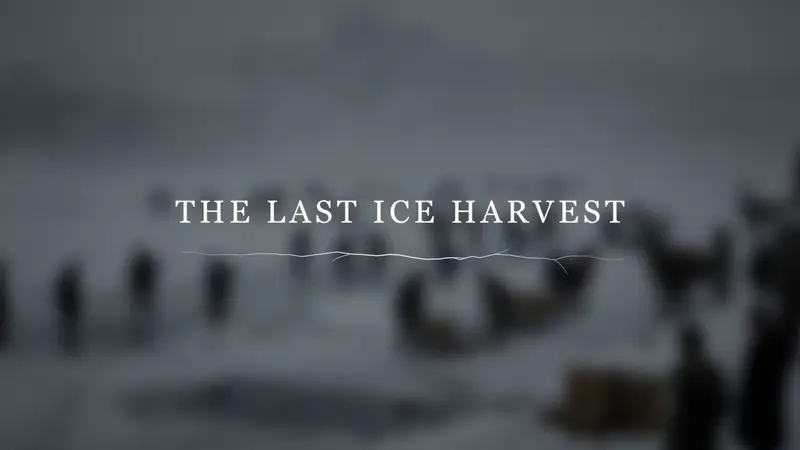
Title card reading The Last Ice Harvest, over a blurred winter river with ice cutters AI background

The Last Ice Harvest

How winter ice became a global trade, and why Prague's harvest ended with a dam.

Runtime
3:52
Shots
35
All-in
~$64
Working
~2 h 05

The proof of concept. Most of the pipeline was built while making it. 23 AI images, 2 archival photos, maps, infographics and 3D.
Title card reading The Little Red Dots, above a single faint red point of light from a JWST image

The Little Red Dots

JWST keeps finding tiny red points of light in the early universe. What are they? The 2026 argument, explained.

Runtime
4:43
Shots
32
All-in
~$101
Working
~2 h 33

Zero AI images. Real JWST imagery and data, spectra drawn from archive files, graphics and 3D visualizations.

Contact sheet · frames from the finished films The Last Ice HarvestThe Little Red Dots
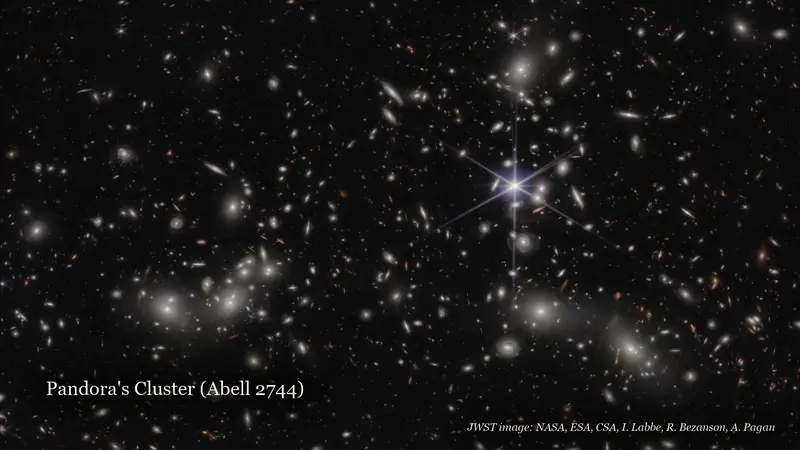
  1. JWST deep field of Pandora's Cluster, thousands of galaxies, with the film's lower third

    s01a deepzoom00:03

    Real · NASA, ESA, CSA, I. Labbe, R. Bezanson, A. Pagan · CC BY 4.0

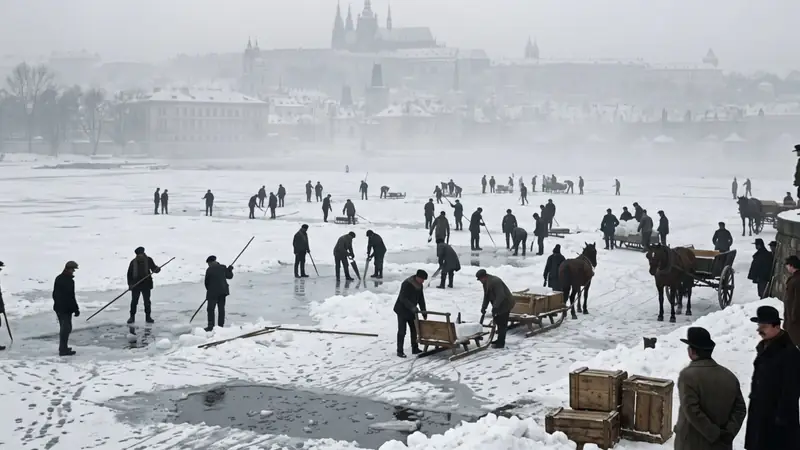
  2. AI image: ice cutters with horses on a frozen river below Prague Castle in winter mistAI image

    s01c parallax00:22

    AI · Leonardo, Nano Banana 2.1

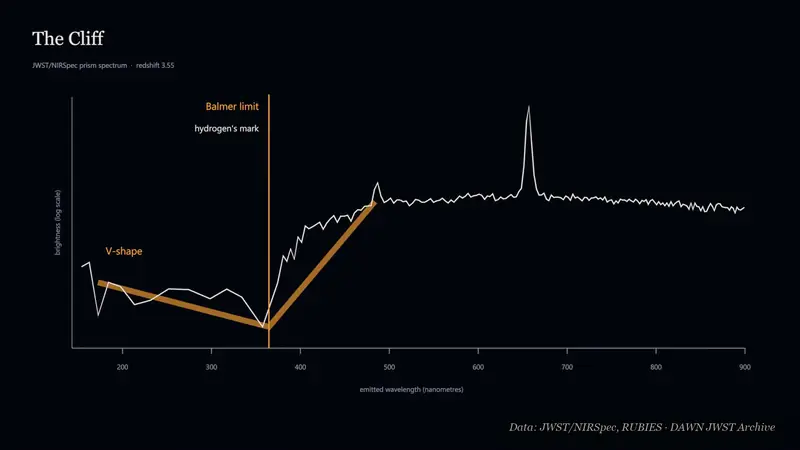
  3. A spectrum plot with a V shape that bends at a line marked Balmer limit

    s04e spectrum02:19

    Data graphic · JWST/NIRSpec, RUBIES · DAWN JWST Archive

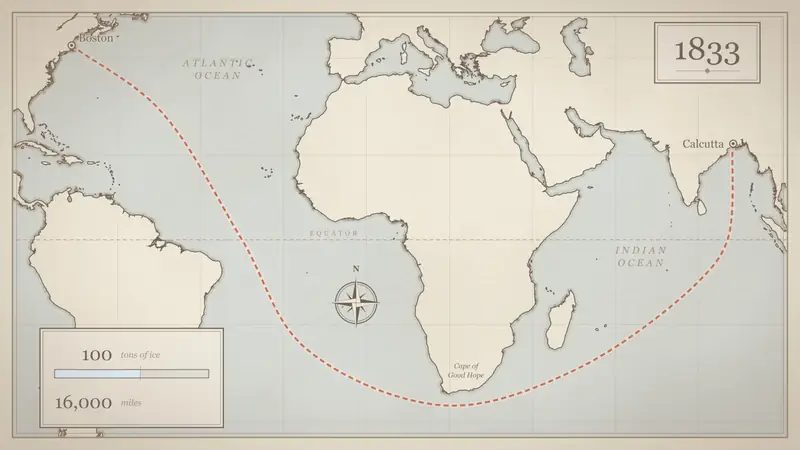
  4. Antique-style map of the 1833 voyage from Boston around Africa to Calcutta, with counters for 100 tons and 16,000 miles

    s03b map01:16

    Map · Natural Earth data

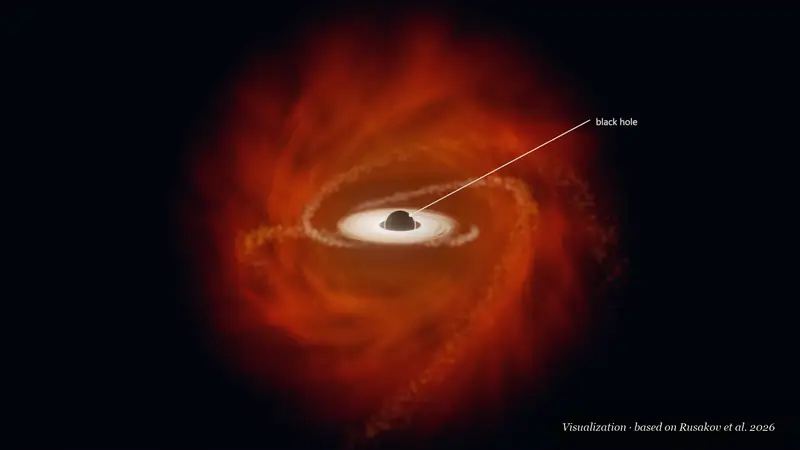
  5. 3D visualization of a small black hole with a bright disk inside a cloud of glowing orange gas

    s05c 3d02:45

    Visualization · after Rusakov et al. 2026

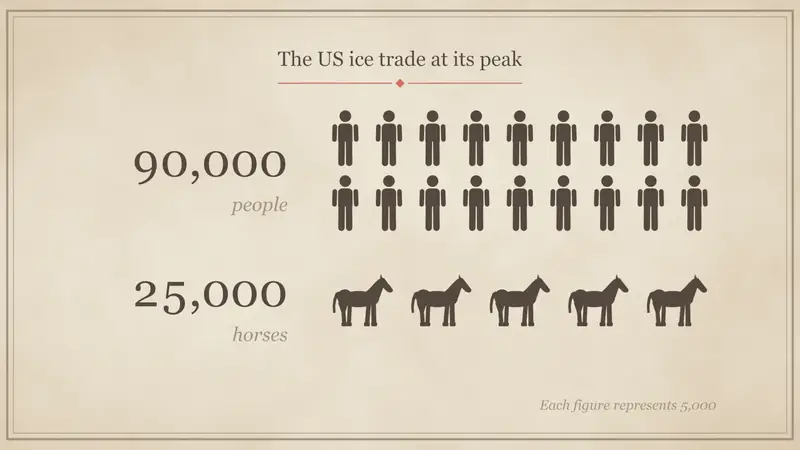
  6. Infographic: the US ice trade at its peak, 90,000 people and 25,000 horses as pictograms

    s04c infographic01:39

    Graphic · Blender

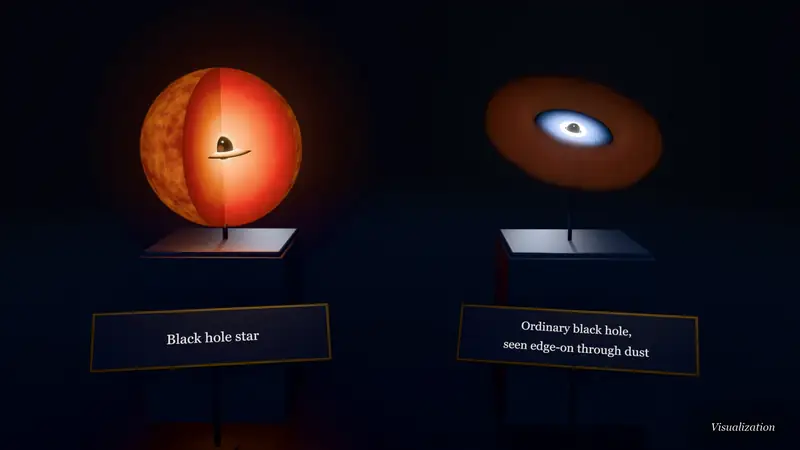
  7. Two museum-style 3D models on plinths: a black hole star and an ordinary black hole seen edge-on through dust

    s06e 3d03:47

    Visualization · Blender

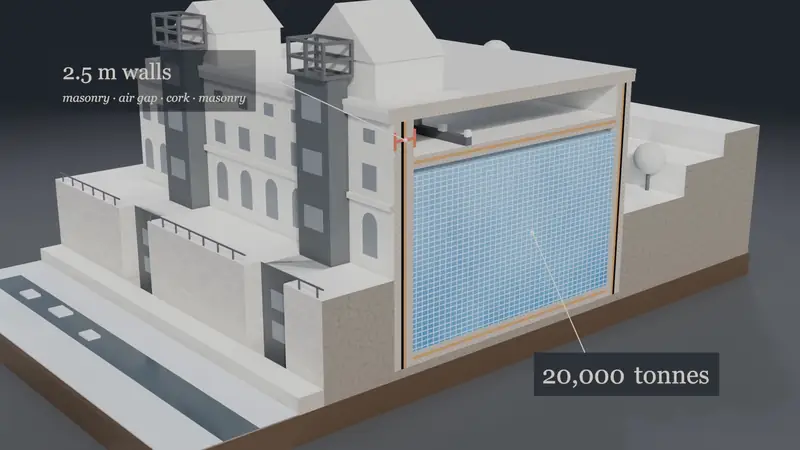
  8. 3D museum-model cut-away of the Braník ice house showing 2.5 metre walls and a block of 20,000 tonnes of ice

    s07g 3d02:56

    3D reconstruction · from the 1913 photograph

Each frame is labelled with its shot ID and technique from the film's storyboard, and its time in the film. AI images carry a badge here and in every new film. Full credits are at the foot of the page.

Process · 11 stages · 2 approval gates

One storyboard drives every stage

Each film is one folder and one storyboard file. Every stage reads the storyboard and caches what it makes, so a change re-does only the shots it touches. The producer is asked at the gates and for matters of taste. Everything else runs on its own.

  1. 1

    Idea and concept

    Angle, length, audience and narrator.

    Outputconcept.md

    Producer decides
  2. 2

    Research

    One agent researches the facts, another finds real imagery and its licences. Every fact is sourced and tagged with a confidence level.

    Outputresearch/notes.md · research/images.md (catalogue with licence and credit lines)

    Agents
  3. 3

    Layout

    Sections, timing, visuals per section, image policy and the music plan.

    Outputlayout.md

    Producer approves
  4. 4

    Script

    Narration by section, a fact-check table and a list of phrases to avoid.

    Outputscript.md

    Gate 1 · producer approves
  5. 5

    Storyboard

    Shots, techniques, sources and licences, camera, overlays, sound effects, music movements and silent passages. A validator checks it against the script and the trust rules.

    Outputstoryboard.yaml · review page out/storyboard.html

    Gate 2 · producer approves

No credits are spent above this line

  1. 6

    Assets

    Downloads of real imagery, data and footage. AI images only where the storyboard allows them.

    Outputassets/archival/ · assets/images/

    Producer approves the download list
  2. 7

    Narration

    One text-to-speech call per section. Its character timings become the film's timeline.

    Outputassets/voice/ · out/timeline.json

    Voice audition first
  3. 8

    Score

    One piece with one movement per act, its lengths taken from the timeline. Cuts snap to the music's onsets.

    Outputassets/music/ · out/beats.json

    Runs on its own
  4. 9

    Shots

    Blender and Python renderers, one per technique. New techniques are built by agents working in parallel, each in its own files.

    Outputshots/<id>.mp4

    Runs on its own
  5. 10

    Mix

    Dissolves, overlays (lower thirds, captions, credits, AI badges, titles over picture), ducked music, sound effects, loudness at −14 LUFS and an .srt file.

    Outputout/<slug>.mp4

    Runs on its own
  6. 11

    Review

    Frames pulled from every shot, flicker checks, reading times and loudness. Then the producer watches. Fixes go back to stages 5–10.

    Outputfixes and lessons for the pipeline

    Producer watches

One film per fresh session

Long conversations get expensive, because every step re-reads the whole context. The repository docs carry everything over to the next session.

Agents for parallel pieces

Research and new renderers go to agents. Each gets its own files, a clear brief and shared conventions. Their reports are checked before anyone believes them.

The producer at the gates

Concept, script, storyboard, downloads and voice, plus matters of taste. Nothing that costs credits happens before the storyboard is approved.

Verify by looking

Contact sheets, frames pulled from the final film, an automatic flicker check. Rendering without looking cost a re-render twice.

Tools · prices as of October 2026

The crew, the services and the machine

Every tool used on the two films, what it does here, and the settings that worked.

Claude and agents

The crew

Claude Opus 5.5 at the default effort runs the production: research, layout, script, storyboard, all of the pipeline's code, the renders and the mix, and the checks. Agents take the independent pieces, such as research and new renderers.

Research
Two agents: one for facts (sourced, confidence-tagged), one for real imagery and licences
Builders
New renderers are written by parallel agents in separate files; shared code is read-only for them
API prices
$4 input · $20 output · $0.20 cache read · $5–8 cache write, per million tokens

ElevenLabs

Narration, music, sound

All audio, through the API. Creator plan, $22 a month for 131,000 credits. The free plan has no commercial licence.

Narrator
“George”, a warm British storyteller, on eleven_v4, about 14.4 characters a second. One request per section with character timestamps, which drive the cuts
Music
music_v2_5. One continuous score made of chunks, one per movement (3–120 s each). Roughly 900 credits a minute
Sound effects
0.5–30 s each, about 100–200 credits
Key
Restricted to the endpoints the pipeline uses, with a monthly credit cap. It lives only in a local file

Leonardo

AI images and video, where allowed

Web interface only, with no API. The producer logs in; Claude drives the page in a browser and reads each result back.

Images
Nano Banana 2.1, 16:9. Medium 2752×1536 = 64 credits (Small 1376×768 = 43). Prompt Enhance off, no style preset
Video
MiniMax H3, Turbo, HD 1376×768, 6 s = 90 credits. Standard quality costs 390–684; Seedance 2.0 Mini 960
References
For a reconstruction, the real photo goes along as an image reference
Quirk
About 10 generations at once; extra ones are silently dropped, so the helper checks that the credit balance actually falls

Blender 5.1

Graphics, 3D, image moves

Headless EEVEE renders. Each shot is a self-contained job with absolute paths, frames, narration timings and the style palette.

Render time
Ken Burns ~0.2 s a frame; 3D ~0.5–1 s a frame. An 8 GB GPU shared by agents is the bottleneck
Techniques
Eight, from Ken Burns to 3D templates. See the table below

Python renderers

Deep zoom, footage

Two techniques that run without Blender and write the same frames, so caching and previews work the same way.

deepzoom
One continuous zoom into a giant image, such as a 2.3-gigapixel JWST mosaic, aimed by the sky coordinates stored in the file
footage
Trims, crops and mutes real video. Music in agency footage is never covered by the licence, so it is always muted

Depth Anything V2 Small

Depth for parallax

Turns a still photo into a depth map, so the camera can move through a real picture without inventing anything.

Licence
Apache-2.0. The Base and Large models are non-commercial, so they are not used
Speed
0.3 s per image on the GPU. Depth is blurred slightly to stop tearing at silhouettes

ffmpeg 8

The mix

Assembles the film from the rendered shots, the narration, the score and the effects.

Picture
Dissolves, lower thirds, captions, credits, AI badges, titles over picture
Sound
Music ducked under the voice, effects placed per shot, loudness −14 LUFS
Delivery
MP4 at 1080p plus an .srt sidecar. No burned-in subtitles

The machine

One desktop

Everything renders locally. Electricity for a film costs less than €1.

Hardware
Windows 11 · RTX 5060 with 8 GB
Software
Blender 5.1.1 · ffmpeg 8 · Python 3.12 via uv · PyTorch 2.11 with CUDA 12.8 (needed for the RTX 50 series)

Blender techniques

TechniqueWhat it doesExample on this page
kenburnsSlow moves over a still; fit: contain keeps labelled plates wholeBraník, 1913 · six-dot mosaic
parallaxDepth relief from a depth map, with a moving cameraPrague in winter (AI image)
mapAntique-style maps from Natural Earth and OpenStreetMap dataBoston to Calcutta, 1833
infographicCounters, bars, timeline, scale with a “region” mode, statements, checklist, mass drop, scales90,000 people · size to scale
cardTitle, newspaper, paper and end cardsBoth title cards
gridA grid of real cutouts appearing one by one
spectrumSpectra drawn from real archive data files (FITS)“The Cliff”
3dTemplates: ice plough, Braník cut-away, redshift, suspects, host galaxy, gas cocoon, scatteringBraník cut-away · cocoon · suspects

Where the real material comes from

Real imagery comes first. Every source is recorded with its licence before the storyboard is approved.

SourceLicence and credit
NASA / STScIGenerally public domain; the credit line given on the page is used
ESA/WebbCC BY 4.0: full credit line on the end card, changes noted
ESA (esa.int)ESA Standard Licence: documentary and educational use allowed, commercial use needs permission. Footage music is never included
Wikimedia CommonsChecked file by file; licence and author saved with each download
DAWN JWST Archive“Released for use by anyone”; the archive and the surveys are cited
Natural EarthPublic domain
OpenStreetMap© OpenStreetMap contributors (ODbL)
Scientific papersOnly CC BY versions are adapted; paywalled figures are off-limits

Costs · measured · prices as of October 2026

What the two films cost

Measured from the service dashboards and from the token usage of every request in the session transcripts. Claude's figures are what the same work would cost at API prices. The films were actually made on subscriptions, which cost far less. Estimates are marked as estimates.

All-in cost per film, at API prices

Claude, main session Claude, agents ElevenLabs and Leonardo (estimate, upper end shown)

The Last Ice Harvest~$64

$22.60 $35.92

The Little Red Dots~$101

$33.88 $65.49

The Ice film's numbers include building most of the pipeline. The Red Dots film added deep zoom, footage, the grid, spectra, new graphics and the cocoon templates, built by seven agents.

The full breakdown

The Last Ice Harvest (3:52)The Little Red Dots (4:43)
Shots35: 23 AI images, 2 archival photos, maps, infographics, 3D32: 15 real and credited, 0 AI images, graphics, spectra, 3D
ElevenLabs credits~7,500 (including auditions)~7,000 (narration ~2,000, score ~4,300, effects ~700)
… as a share of the $22 plan~$1.25~$1.20
… at API or overage rates (estimate)~$1.50–2.50~$1.50–2.50
Leonardo credits1,536 (24 × 64)0
… in money (estimate)~$2–4$0
Claude at Opus 5.5 API prices (measured)$58.52 (main $22.60 + 4 agents $35.92)$99.37 (main $33.88 + 7 agents $65.49)
Claude as a share of a $100/month Max plan~$6 (upper bound)~$10–11 (upper bound)
All-in at API prices~$64~$101

Where Claude's cost goes

Both films together: 1,246 requests and about $158 at API prices. Most of it is the model re-reading its own context at every step.

Cache reads
re-reading context
$70 · 351 M tokens
Cache writes
$47 · 8.2 M tokens
Output
$41 · 2.0 M tokens
Input, uncached
~$0 · ~3 k tokens

The main lever is starting each film in a fresh session. At 800k+ tokens of context, every step re-reads about $0.16.

The next levers: fewer builder agents, now that the renderers exist, and Sonnet 5.5 for research and cataloguing agents.

The subscriptions behind it

Nothing was charged beyond these plans.

Claude Max

$100 a month

Both films used at most ~73% of one week's limit, about $17 of plan value. Extra usage was switched off.

ElevenLabs Creator

$22 a month · 131,000 credits

Both films used ~11% of the month's credits.

Leonardo

Existing plan · ~34.6k credits

~1.5k credits used, all on the Ice film.

Estimate a film

A rough model for the next film, built from the measured numbers above. It is an estimate, and it says where it is guessing.

5 min
Measured so far: 3:52 and 4:43.
0
64 credits each. Archive first: the last film used none.
0
6 s each, 90 credits. A few at most, labelled “AI-animated”.
Rough total at API prices ~$42–83
ClaudeFresh session reusing existing renderers
~$40–80
ElevenLabs7,000–10,000 credits
~$1.50–2.50
Leonardo0 credits
$0
GPU and electricity
< €1
Active timePlus the producer's review time
~2–3 h

How it works: ElevenLabs scales with runtime from the 7–10k credits expected for 5 minutes. Leonardo counts credits and converts them at the rate the Ice film paid (1,536 credits ≈ $2–4). Claude is the measured range for a 5-minute film; it depends on how many steps the session takes, more than on runtime.

The model for a 5-minute film

ItemExpected
ElevenLabs7–10k credits (~$1.50–2.50)
Leonardo0–25 images × 64 credits (~$0–4); video clips 90 credits each, a few at most
Claude, API-equivalent~$40–80 in a fresh session reusing existing renderers (more if new techniques are needed)
GPU and electricity< €1
Active time~2–3 h, plus the producer's review time

Compared with a studio

A studio would quote roughly $15,000–45,000 for a comparable 4–5 minute documentary with research, motion graphics, some 3D, narration and an original score. Motion graphics run about $3–8k per minute and 3D about $6–18k per minute, plus weeks of schedule. A freelancer might charge $5,000–15,000.

Cost of a 4–5 minute documentary · log scale, each gridline is ten times the last

Studiobenchmark
$15k–45k
Freelancerbenchmark
$5k–15k
Our two filmsall-in, API prices
Ice ~$64 Dots ~$101

The benchmarks come from vendor blogs, not quotes. The comparison is not like for like: our figures leave out the producer's own time, the hardware and the fixed monthly plans, and a studio's price pays for human craft, revisions and a schedule.

Time · from session timestamps

How long the films took

Clock span runs from start to finish, pauses included. Working time counts the main session and the agents, with overlaps counted once. Agent time adds up every agent's run, so it can exceed working time when agents run in parallel.

The Last Ice Harvest The Little Red Dots

Clock span

5 h 02 m
10 h 04 m incl. a night

Actual working time

~2 h 05 m
~2 h 33 m

Agent time, all agents added up

2 h 30 m · 4 agents
3 h 59 m · 7 agents

Where machine time goes

  • A Ken Burns shot renders at about 0.2 s a frame; a 3D shot at 0.5–1 s a frame.
  • A depth map takes 0.3 s per image on the GPU.
  • An 8 GB GPU shared by several agents is the bottleneck. On the Red Dots film, up to five agents ran in parallel.
  • Stages cache their output, so a fix re-renders only the shots it touches.

The next film

  • Expected active time: ~2–3 h, plus the producer's review.
  • The producer's time is spent at the gates (concept, script, storyboard, downloads, voice) and in review. It is not included in the figures above.
  • Most renderers now exist, so fewer builder agents should be needed.

Case studies · 2 films

What we made, and what the producer sent back

Finished films are not changed after review. The lessons go into the pipeline and the rules for the next film.

The Last Ice Harvest

Proof of concept3:5235 shots~$64 all-in~2 h 05 m working time

The brief: the story of natural ice harvesting, leading to Prague.

Research changed the story

The brief said Prague was the last place ice was harvested. The research did not support that: Plzeň's brewery harvested until 1987, and harvests still run in New Hampshire, Harbin and at the Icehotel. The script says instead that Prague's Vltava harvest outlived the Atlantic trade, into the 1950s, and ended because the Slapy dam (1954) stopped the river from freezing.

Lesson: research before the script, and flag any premise the sources do not carry.

What was made

  • 35 shots in three looks: period (AI photo style), engraving (archival look) and present day.
  • Maps of the Atlantic trade from Natural Earth, and of Prague's river from OpenStreetMap.
  • Infographics and 3D: an ice plough and the Braník ice-house cut-away.
  • Narration by George on eleven_v4; ElevenLabs music and effects.
  • 23 AI images from Leonardo (Nano Banana 2.1, Medium).
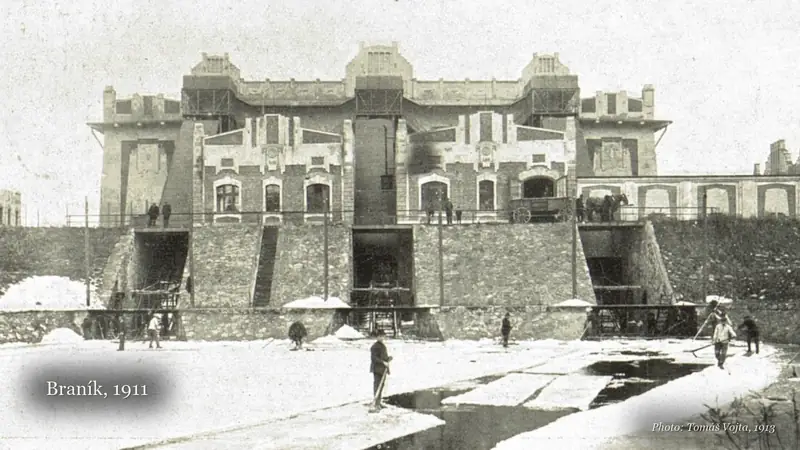
Black-and-white 1913 photograph of the Braník ice house above its stone embankment, with the film's lower third Braník, 1911
The real Braník ice house in 1913, as it appears in the film.s07f · kenburns · Photo: Tomáš Vojta, 1913 · public domain, via Wikimedia Commons
3D cut-away of the same ice house, showing the thick walls and the frozen mass inside, labelled 2.5 m walls and 20,000 tonnes
The producer's favourite shot: a museum-model cut-away built from that photo, showing what the photo cannot.s07g · 3d · Blender reconstruction
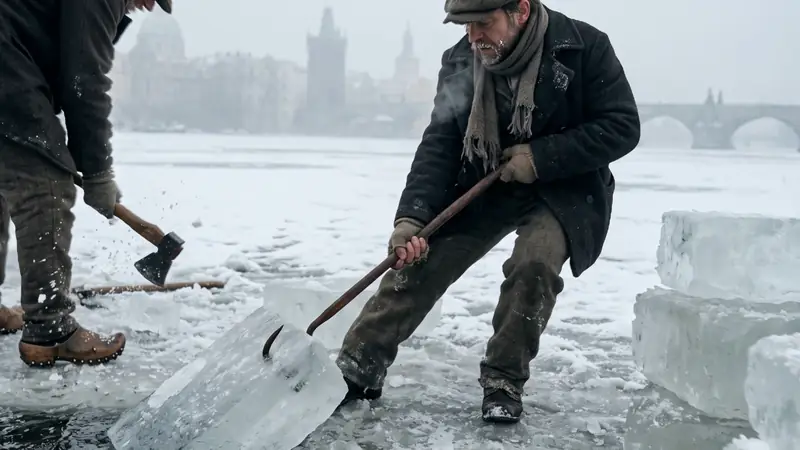
AI image: an ice man on a frozen river hauling a block of ice with a long iron hook, Charles Bridge in the mist behindAI image
The review caught this one: the hook in the block does not look right. AI pictures give themselves away on tools and on how objects physically touch. The finished film shows this shot without an AI badge; the badge rule came out of this review.s07e · parallax · AI image: Leonardo, Nano Banana 2.1

The producer's review

“Not bad! Actually quite good.”The producer, after the first cut
  • The AI photos were weak in mechanical detail.
  • AI images must be marked as AI on screen.
  • Real archival photos exist for most of this, so use them first; use AI for graphics and schemas.
  • The 3D cut-away was the favourite: “more of this”. It has a known flicker where two flat faces meet, and was kept.

Built along the way

The whole pipeline: the ElevenLabs client, storyboard validation, the timeline from narration timings, the Blender job runner and its first five techniques, depth parallax, the mix, and the routine that drives Leonardo in the browser.

The Little Red Dots

Science documentary4:4332 shots~$101 all-in~2 h 33 m working time

The brief: a 5-minute film on JWST's “little red dots”, compact red objects in the early universe that may be black holes wrapped in gas. AI images kept to a minimum. In the end there were none.

Approach

  • Layout first, then the script and the storyboard, each approved.
  • A deep zoom into the 2.3-gigapixel UNCOVER mosaic of Pandora's Cluster, aimed by its sky coordinates.
  • Real cutouts from the DAWN JWST Archive in a grid, and real spectra drawn from archive files.
  • ESA separation footage, muted; one credited MPIA illustration.
  • Blender 3D: redshift, the suspects, the host galaxy, the gas cocoon and the scattering.
  • The music leads: one orchestral-electronic score in five movements following the story, cuts snapped to the beat, lighter ducking under the voice.
3D visualization of a small black hole inside a cocoon of dense glowing gas, labelled black hole
The 2026 cocoon idea as a visualization. The real dot dissolves into it, so the hand-off from data to model is visible.s05c · 3d · Visualization based on Rusakov et al. 2026

Review fixes, all applied

What the producer sawWhat changed
Too fast to read: the “infrared, where Webb looks” label appeared in the last seconds of its shot, and a note vanished too soonA reading-time rule for every on-screen text, and the labels moved earlier
Awkward wording: “4–11% of its present age”Rewritten
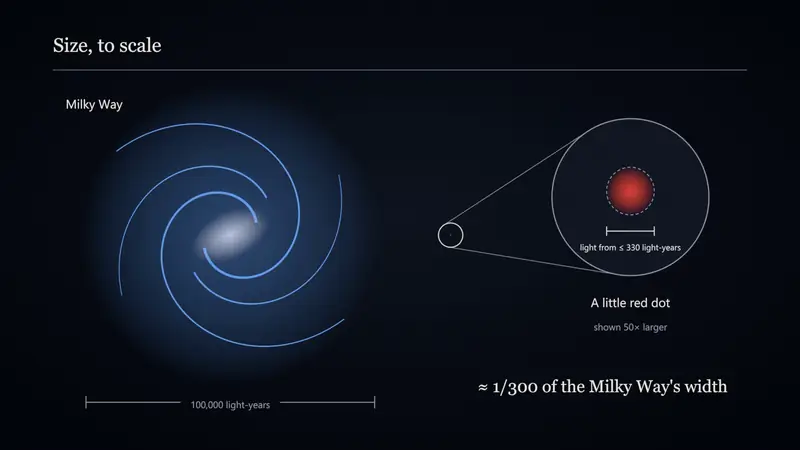
Misleading scale: “330 ly” looked like the size of the dotA region mode for the scale graphic: a glow with a dashed boundary, labelled as the region the light comes from
Abrupt cut: the cocoon animation vanished when the next screen beganIt keeps moving in the background, dimmed under the title
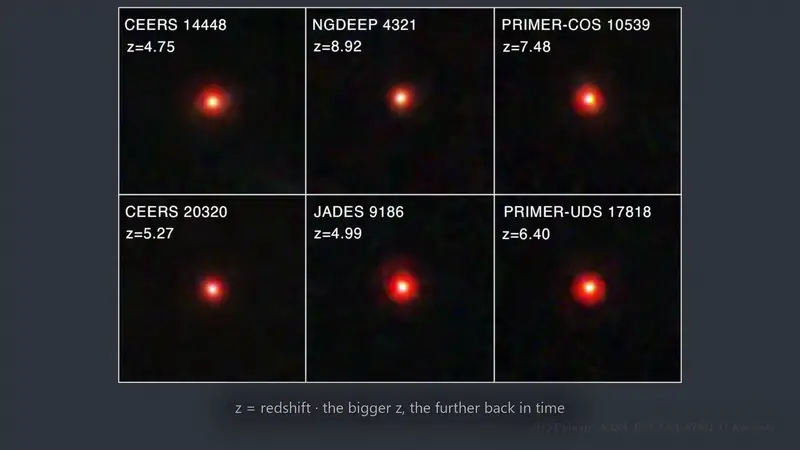
Unexplained jargon: “z”A caption: “z = redshift · the bigger z, the further back in time”
Credits too shortFull CC BY lines on the end card
Subtitles in the pictureNone burned in: the deliverables are the film and an .srt file
Infographic titled Size, to scale: the Milky Way beside a little red dot shown as a glowing region with a dashed boundary, about one three-hundredth of the Milky Way's width
After the fix: the dot is a region of light “≤ 330 light-years” across, drawn with a dashed boundary.s03c · infographic · Blender graphic
Six-panel mosaic of little red dots with their names and redshift values, and the caption z = redshift, the bigger z, the further back in time
A labelled plate kept whole with fit: contain, and the new caption that explains “z”.s03d · kenburns · JWST image: NASA, ESA, CSA, STScI, Dale Kocevski (Colby College) · CC BY 4.0

The overall verdict, as rules for the next film

  • The voice had one level of enthusiasm throughout.
  • There were too many plain image zooms.
  • It felt rushed. The producer wants silent passages with just music and pictures.

Built along the way

The deepzoom, footage, grid and spectrum techniques; the region scale; titles over picture; continuity between 3D shots; snapping cuts to the beat; one score made of movements; re-splitting cached narration without new voice calls; and the AI trust rules in the validator.

Rules · enforced by the pipeline

Viewers always know what is evidence and what is illustration

Real material comes first. AI is only ever illustration, always marked on screen, and never used for faces of real people or for scientific data. The storyboard validator refuses shots that break these rules.

  1. Evidence or illustration

    A shot marked as evidence makes a factual claim through its picture, such as “this is the Braník ice house”. Evidence must be real, or a graphic of real data. The validator refuses AI there.

  2. Never imitate archival formats

    No fake old photos, engravings, newspapers, maps or paper figures, and no real people's faces. AI gets its own recognisable look: painterly or diorama, never “found footage”.

  3. Ground reconstructions in real references

    A real photo travels with the prompt as an image reference, and each AI shot has a fact sheet of details that must be right and things that must not appear. Anything wrong is regenerated or cut.

  4. Put the real next to the reconstruction

    Show the source first and dissolve to the reconstruction, as the real dot dissolves into the cocoon. Use cue words such as “imagine” in the narration. Keep AI shots short.

  5. AI video adds motion, not events

    To move a real photo, use depth parallax, which invents nothing. AI video is only for atmosphere such as snow, water or fog: a few clips per film, labelled “AI-animated”.

  6. Consistent marking, automatic in the mix

    Every AI shot gets the same slightly desaturated look and the same badge in the top left, “AI reconstruction”.

  7. Verifiable

    The end card lists every AI shot, and a log records each one's time, tool, prompt, reference and fact sheet. Not built yet: C2PA content credentials on the final file.

Pacing and voice

10–15%

of the runtime without words: music and pictures only, the longest pause 6–10 s. After the cold open, around the reveal, between acts, and a held ending.

≤ 25%

of shots as plain Ken Burns zooms. Prefer parallax, footage, annotated plates, diagrams and 3D.

1 s + 0.3 s

per word: how long every caption, label or title stays before its cut. A 12-word note needs about 4–5 s.

Range

The narrator is directed per section: calmer for wonder, more urgent for tension, warm for the reveal, quiet at the end. Auditioned first.

−14 LUFS

Loudness of the final mix, with the narration clear over the music.

One shot in the storyboard

Every shot names its source, licence and on-screen credit. This is the six-dot mosaic from The Little Red Dots, abridged.

- id: s03d
  narration: "Yet some pour out as much light
              as an entire galaxy."
  technique: kenburns
  archival: littlereddots.tif
  camera: {move: push_in, amount: 0.04,
           fit: contain, margin: 1.2}
  source:
    type: real
    credit: "NASA, ESA, CSA, STScI,
             Dale Kocevski (Colby College)"
    license: NASA / CC BY 4.0 (ESA/Webb)
    onscreen: "JWST image: NASA, ESA, CSA,
               STScI, D. Kocevski"
  overlays:
    - {kind: caption, text: "z = redshift ·
       the bigger z, the further back in time"}

QA before a cut is shown

  • The storyboard validates: script match, sources and licences, trust rules.
  • Every on-screen text has its reading time before the cut.
  • Labelled plates are shown whole, never cropped.
  • 3D and graphics pass the flicker check and a look at moving frames.
  • Parallax edges and frame borders are clean on the last frame.
  • Credits: a short label on screen, full CC BY lines on the end card, changes noted.
  • AI shots: badge, AI look, end-card list, AI log.
  • Loudness about −14 LUFS; narration clear over the music.
  • Silent passages present; the voice varies by section; plain zooms ≤ ~25% of shots.

Lessons that became rules

  • Watch 3D in motion. Two surfaces at the same height flicker frame to frame. Offset them by a few centimetres.
  • Check parallax at silhouettes and at the frame borders on the last frame.
  • Real photos keep the film honest. The real 1913 photos showed that an AI prompt's description of the building was wrong.
  • Don't sync text to a shot's last words. Narration often runs into the next shot, and the label goes with the cut.
  • Every effect must explain something: a change of scale, a passage of time, a cause. If it doesn't help the viewer understand the next line, it goes.

Coming next · concept only

Monopoly: the stolen game

A game designed to warn against monopolies became one of the most defended monopolies in toys. The next film follows it from Lizzie Magie's 1904 patent for The Landlord's Game, to Charles Darrow's 1935 box story, to the Anti-Monopoly lawsuit that dug up the real history.

Status: ideas only, nothing approved
  • Angle: a detective story about who really invented the game, told with irony, with three “locks” (patent, copyright and trademark) as the recurring visual device.
  • Length: about 7 minutes.
  • Pictures: mostly public-domain patent drawings (1904, 1924, 1935), court opinions and statutes. Real line art drawn on, then built into 3D, and one 3D board that morphs through history.
  • Pacing: at least three silent passages, and few plain zooms.
  • Real people: real public-domain photos only, never AI faces.

Still to decide together

  1. The angle: the stolen game with irony, or a clearer explainer of the three locks?
  2. Length: about 7 minutes, or a tight 5?
  3. Audience: general viewers, or game designers?
  4. Narrator: George again, or a warmer, wryer voice?
  5. Music: ragtime and a 1930s small band moving into modern, as one score in movements?

Draft beat outline, about 7 minutes

BeatTimeWhat happens
01 Cold open0:00–0:40The box story everyone knows: 1935, the Depression, an unemployed man invents a game
02 Rewind to 19040:40–1:40Lizzie Magie, her patent, and a game meant to teach about land and rent
03 The folk game1:40–2:40Copied by hand, street names written in, the rules mutating
04 1935: the product2:40–3:30Darrow sells it to Parker Brothers; Magie's 1924 patent bought for $500
05 The locks3:30–4:15The patent runs out in 1952; the name becomes the fortress
06 The professor4:15–5:151973, Ralph Anspach's Anti-Monopoly, the lawsuit, the archives
07 The ruling5:15–6:051982: the name is ruled generic. 1984: Congress changes the test
08 Today6:05–6:50Game mechanics are free to reuse; art, text and names are not
09 Close6:50–7:10Back to the irony, and a held ending

Times are from the concept draft. The facts still need the usual research pass. MONOPOLY is a trademark of Hasbro; this studio and the planned film are not affiliated with or endorsed by Hasbro.